
Acne Scarring
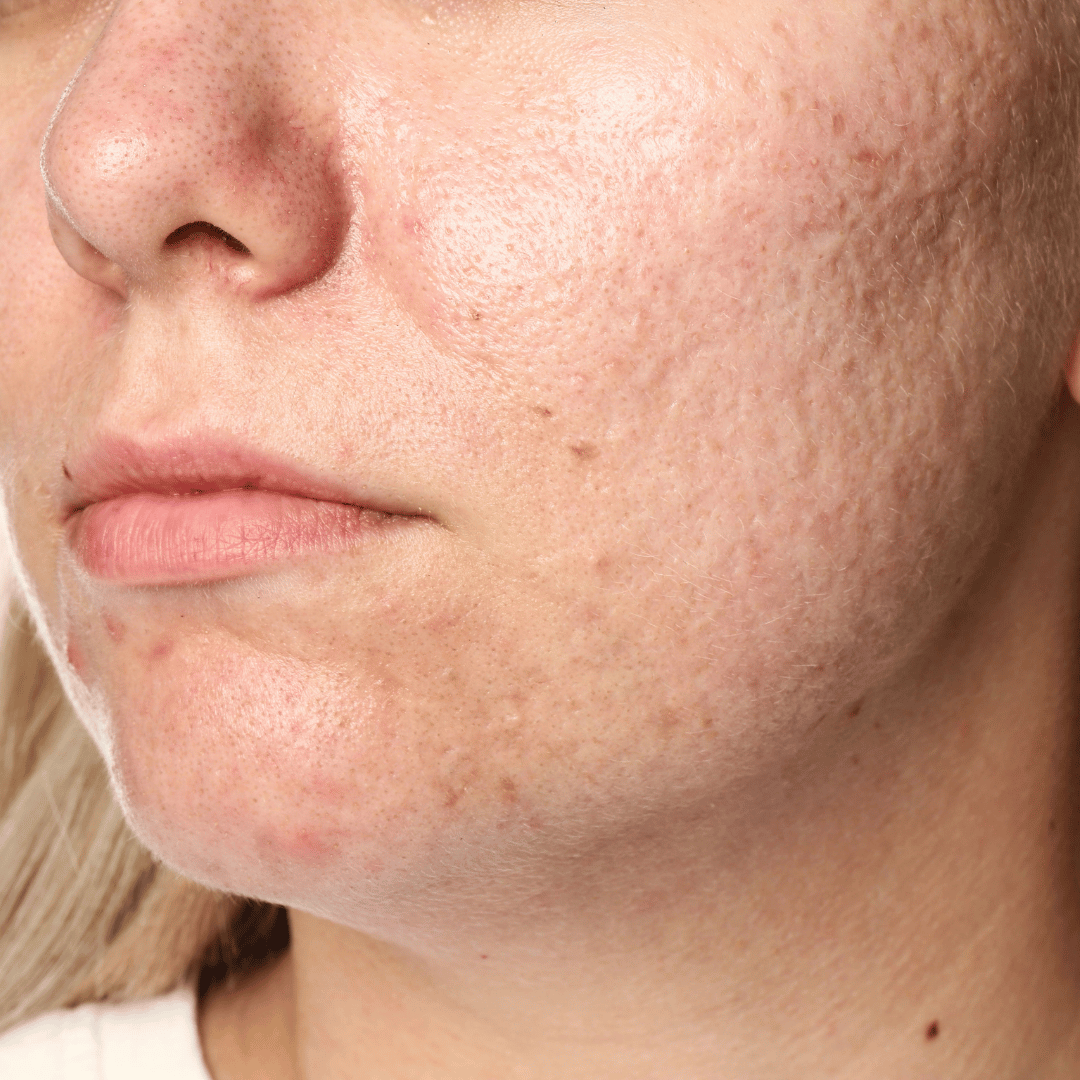
There is no single best treatment for acne scarring. We assess each patient carefully, explain their options honestly, and build a combination-based plan designed to deliver the most meaningful and realistic improvement for their specific presentation.

MEDICAL GROUP
The Spierings Medical Group provides specialist assessment and treatment of acne scarring, offering consultant-led care for patients looking to improve skin texture, tone, and confidence following inflammatory acne. Acne scarring reflects structural changes in the dermis, and treatment must be tailored to scar type, severity, and individual skin biology.
What is Acne Scarring?
Acne scarring refers to permanent structural changes in the skin that occur following the resolution of inflammatory acne. These changes arise when the normal wound-healing process is disrupted, resulting in either loss or excess of collagen within the dermis.
Not every acne lesion leads to a scar. Superficial lesions such as comedones (blackheads and whiteheads) often heal without consequence, whereas deeper inflammatory lesions particularly nodules and cysts carry a significantly higher risk.
What Causes Acne Scarring?
Acne scarring is fundamentally the result of inflammation and abnormal wound healing. When an acne lesion forms, the follicle becomes inflamed and may rupture. This leads to damage within the dermis, triggering a repair response involving collagen production.
Several key mechanisms contribute:
- Depth and severity of inflammation - Deeper lesions (nodules, cysts) extend into the dermis and are more likely to disrupt normal tissue architecture
- Collagen imbalance during healing - Too little collagen leads to depressed (atrophic) scars while too much collagen leads to raised (hypertrophic or keloid) scars
- Mechanical trauma - Picking, squeezing or manipulating lesions increases inflammation and significantly raises the risk of scarring
- Individual susceptibility - Genetic predisposition influences how the skin heals and whether abnormal scarring occurs
In practical terms, acne scarring reflects how the skin responds to injury, not simply how severe the acne appears clinically.
What are the Types of Acne Scarring?
Most patients present with a combination of scar types, rather than a single uniform pattern.
- Atrophic (depressed) scars - These are the most common and result from loss of collagen:
- Ice pick scars: Deep, narrow tracts extending into the dermis
- Boxcar scars: Well-defined depressions with sharp edges
- Rolling scars: Broad depressions with sloping edges, creating an undulating texture
*These typically occur on the cheeks and temples and contribute to overall skin irregularity.
- Hypertrophic and keloid scars - These arise from excess collagen production during healing:
- Hypertrophic scars: Raised but confined to the original lesion
- Keloid scars: Extend beyond the initial site of injury
*They are more frequently seen on the chest, back, and jawline, and may be symptomatic (itchy or tender).
How is Acne Scarring Treated?
Management of acne scarring is guided by a simple principle: treatment must be tailored to scar type, severity, and skin biology. There is no single best treatment. Instead, combination approaches are often required.
- Foundational Principle - Control active acne first. Ongoing inflammation perpetuates scarring. Effective acne treatment is therefore a prerequisite, not an adjunct.
- Topical and Non-Invasive Approaches - These play a supportive role rather than eliminating established scars:
- Retinoids promote cell turnover and collagen remodelling
- Chemical exfoliants (e.g. AHAs) improve superficial texture
- Photoprotection prevents contrast between scarred and normal skin
*These are most useful for early or mild textural change, not deep scars.
- Procedural Treatments - Most meaningful improvement comes from in-clinic procedures, selected based on scar morphology:
- Collagen-stimulating treatments such as microneedling (with or without radiofrequency) and laser resurfacing aim to induce controlled dermal injury, stimulating new collagen formation
- Resurfacing techniques like chemical peels and dermabrasion remove superficial layers and promote regeneration of smoother skin
- Volume restoration including dermal fillers is used to elevate depressed scars by replacing lost volume
- Subcision breaks fibrous bands tethering the scar to deeper tissue
- Punch excision or grafting is reserved for well-defined, deep scars such as ice pick scars
- Intralesional corticosteroid injections reduce collagen overproduction and flatten hypertrophic or keloid scars
Acne scarring is not a cosmetic triviality, it is a structural consequence of inflammation. Early, effective acne treatment remains the most reliable method of prevention.

Choosingtherightdoctororclinicshouldn'tfeelrushed.
If you have a question or want to know more before booking, just ask!