
Psoriasis
We take a structured, evidence-based approach to management, from topical therapy for mild disease through to systemic and biologic treatment where needed, always with a focus on long-term disease control rather than short-term clearance alone.

MEDICAL GROUP
The Spierings Medical Group provides specialist diagnosis and management of psoriasis, offering consultant-led care for patients across all clinical presentations and severities. Psoriasis is a chronic, immune-mediated inflammatory disease and its visible features are a manifestation of deeper immune activity, which is why purely surface-level approaches are often insufficient.
What is Psoriasis?
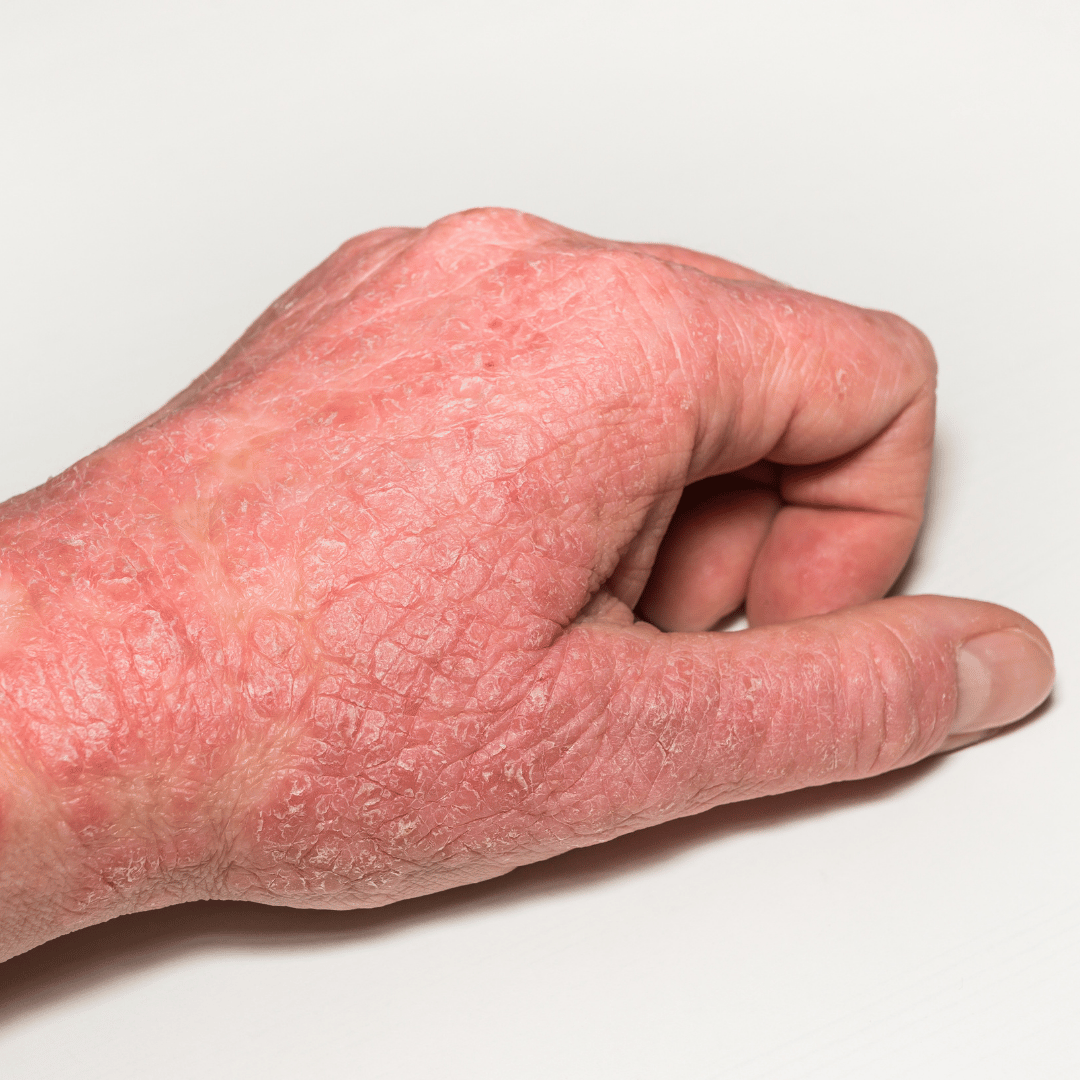
Psoriasis is a chronic, immune-mediated inflammatory disease that primarily affects the skin, though its impact extends beyond it. It is not simply a disorder of dryness or surface irritation, but a condition driven by dysregulation within the immune system.
In normal skin, keratinocytes mature and are shed over approximately four weeks. In psoriasis, this cycle is markedly accelerated, occurring within a matter of days. As a result, immature skin cells accumulate at the surface, forming the characteristic thickened, erythematous plaques with an overlying scale.
While the skin findings are the most visible feature, psoriasis is increasingly recognised as a systemic condition, with potential associations including joint involvement and broader inflammatory effects.
What are the Types of Psoriasis?
Psoriasis presents in several clinical forms, each with distinct features and, at times, different triggers.
- Plaque Psoriasis - The most common variant. It is characterised by well-demarcated, raised plaques with a red base and silvery-white scale, typically affecting the scalp, elbows, knees, and lower back.
- Guttate Psoriasis - Often seen in younger individuals and frequently triggered by streptococcal infection. It presents as multiple small, drop-like lesions distributed across the trunk and limbs.
- Inverse Psoriasis - Occurs within skin folds such as the axillae, groin, and inframammary areas. Lesions are smooth, erythematous, and lack the typical scaling seen in plaque psoriasis due to the moist environment.
- Erythrodermic Psoriasis - A rare but severe presentation involving widespread redness and inflammation across most of the body surface. It represents a dermatological emergency requiring urgent medical care.
What Causes Psoriasis?
Psoriasis is driven by a complex interaction between the immune system and skin cell turnover. At its core is an overactivation of immune pathways particularly involving T-cells, which release inflammatory signals that stimulate keratinocyte proliferation. This results in rapid epidermal turnover and incomplete cell maturation.
Genetic predisposition plays a significant role, though the condition typically requires an external or internal trigger to manifest. Environmental factors such as stress, infection, skin trauma (the Koebner phenomenon), and certain medications can initiate or exacerbate the inflammatory cascade.
Psoriasis is not a surface-level condition. The visible plaques are a manifestation of deeper immune activity, which explains why purely cosmetic or over-the-counter approaches are often insufficient.
How is Psoriasis Treated?
Management is guided by disease severity, distribution, and the presence of systemic involvement. The aim is to reduce inflammation, normalise skin cell turnover, and maintain long-term control.
- Topical Therapy - For mild to moderate disease, prescription topicals remain first-line:
- Corticosteroids to reduce inflammation
- Vitamin D analogues to regulate keratinocyte proliferation
- Keratolytic agents to reduce scaling and improve penetration of active treatments
- Phototherapy - Controlled exposure to narrowband ultraviolet B (NB-UVB) light can suppress cutaneous immune activity and slow epidermal turnover. This is typically administered in a clinical setting.
- Systemic Therapy - For more extensive or resistant disease, systemic treatment may be required:
- Oral medications that modulate immune response
- Biologic therapies that target specific inflammatory pathways with greater precision
These treatments are particularly relevant in moderate to severe psoriasis or when joint involvement is present.
Psoriasis is a chronic condition with a relapsing course. Management is not centred on short-term clearance alone, but on long-term disease control and prevention of flares. Assessment often extends beyond the skin, particularly in patients with symptoms suggestive of psoriatic arthritis or other inflammatory comorbidities.
Maintaining hydration of the skin barrier and avoiding unnecessary irritation can improve comfort and treatment tolerance. However, it is important to recognise that skincare alone cannot address the underlying immune mechanisms driving the disease. Photoprotection remains important, particularly when using treatments that may increase skin sensitivity.

Choosingtherightdoctororclinicshouldn'tfeelrushed.
If you have a question or want to know more before booking, just ask!