
Laser Hair Removal
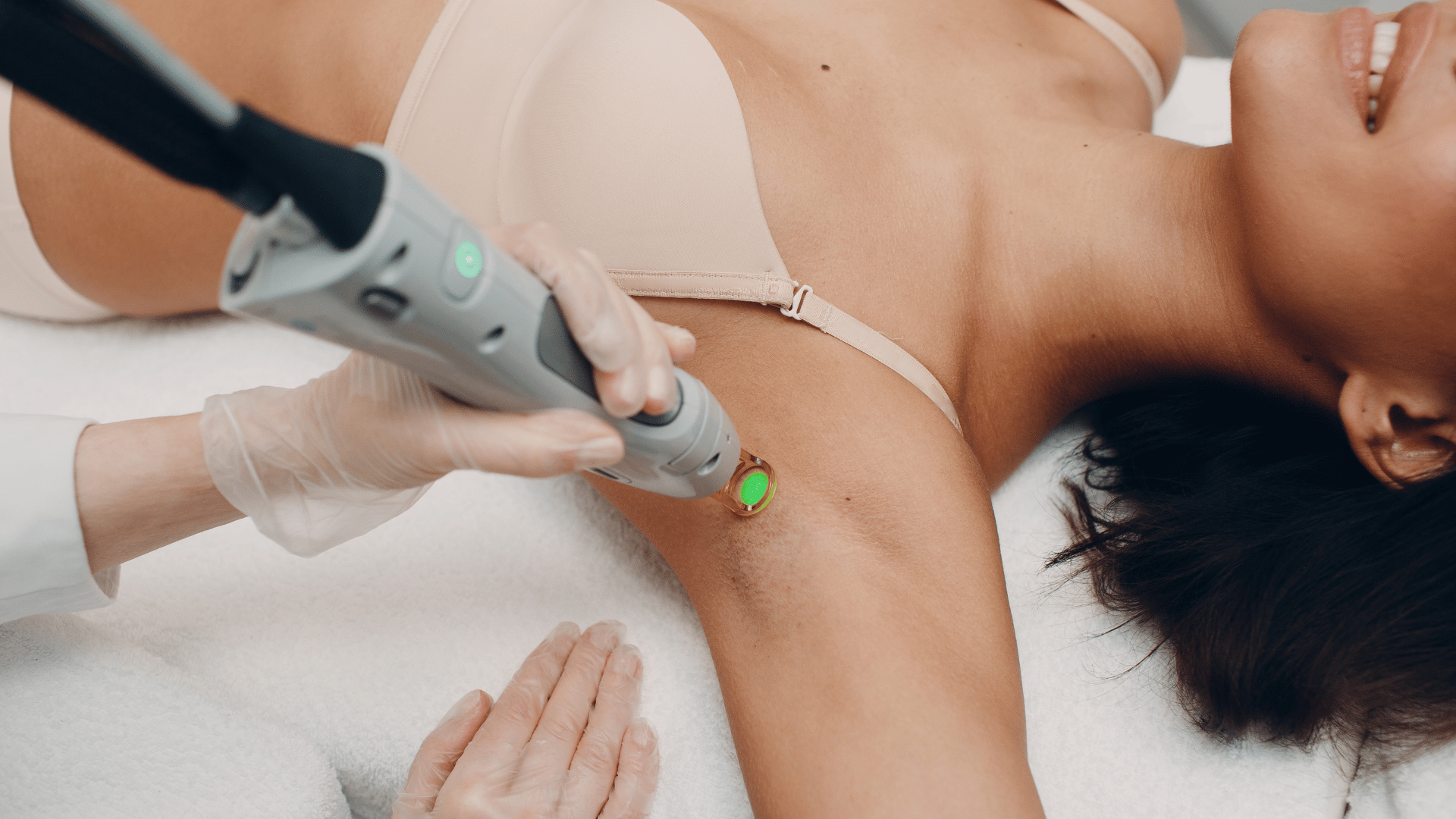
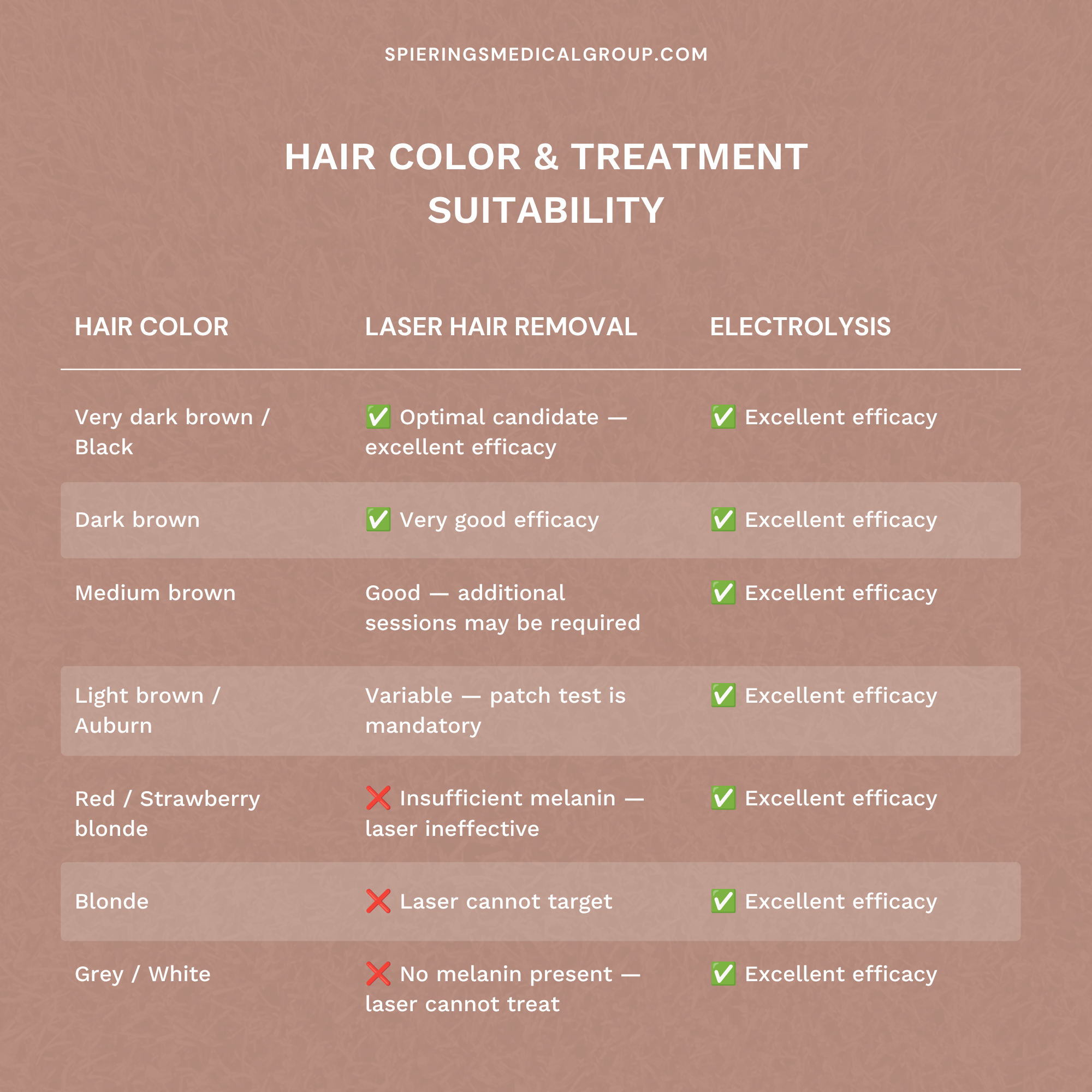
Appropriate patient selection is fundamental to both safety and efficacy. The single most important variable is the degree of contrast between the melanin content of the hair and the background melanin of the skin. Every patient is assessed thoroughly before treatment begins.
MEDICAL GROUP
The Spierings Medical Group offers specialist laser hair removal, providing clinically overseen, evidence-based treatment for patients looking to achieve long-term reduction of unwanted hair. Laser delivers concentrated pulses of light that are absorbed by melanin in the hair shaft, converting to heat that travels down to the follicle and damages its capacity to regrow hair — without injuring the surrounding skin. Speed is laser's primary advantage: each pulse treats multiple hairs simultaneously, making it highly efficient for larger areas.
How Laser Hair Removal Works
Laser delivers concentrated pulses of light that are absorbed by melanin (pigment) in the hair shaft. This energy converts to heat, which travels down to the follicle and damages its capacity to regrow hair without injuring the surrounding skin. Speed is laser's primary advantage: each pulse treats multiple hairs simultaneously, making it highly efficient for larger areas.
Why Multiple Sessions Are Necessary
At any given moment, each follicle on the body is at a different stage of its natural growth cycle — anagen (active growth), catagen (transition), telogen (resting), and exogen (new cycle). Treatment is only effective during the anagen phase, when the hair is actively connected to the follicle and can be reached. Hairs in catagen or telogen phases will not be affected and must be treated in a subsequent session once they have re-entered anagen. This is why a course of treatment — not a single session — is the clinical standard.
How Many Sessions Will I Need?
The clinical standard is 6 to 8 sessions, spaced 4 to 8 weeks apart depending on the area. Facial hair requires more frequent intervals (4 weeks); body areas can be spaced further apart (6 to 8 weeks). A full course typically spans 9 to 12 months.
Hormonal changes — including pregnancy, menopause, and certain medications — can stimulate new follicle activity over time. Occasional top-up sessions may be recommended following a completed course.
Laser vs Electrolysis — How Do They Compare?
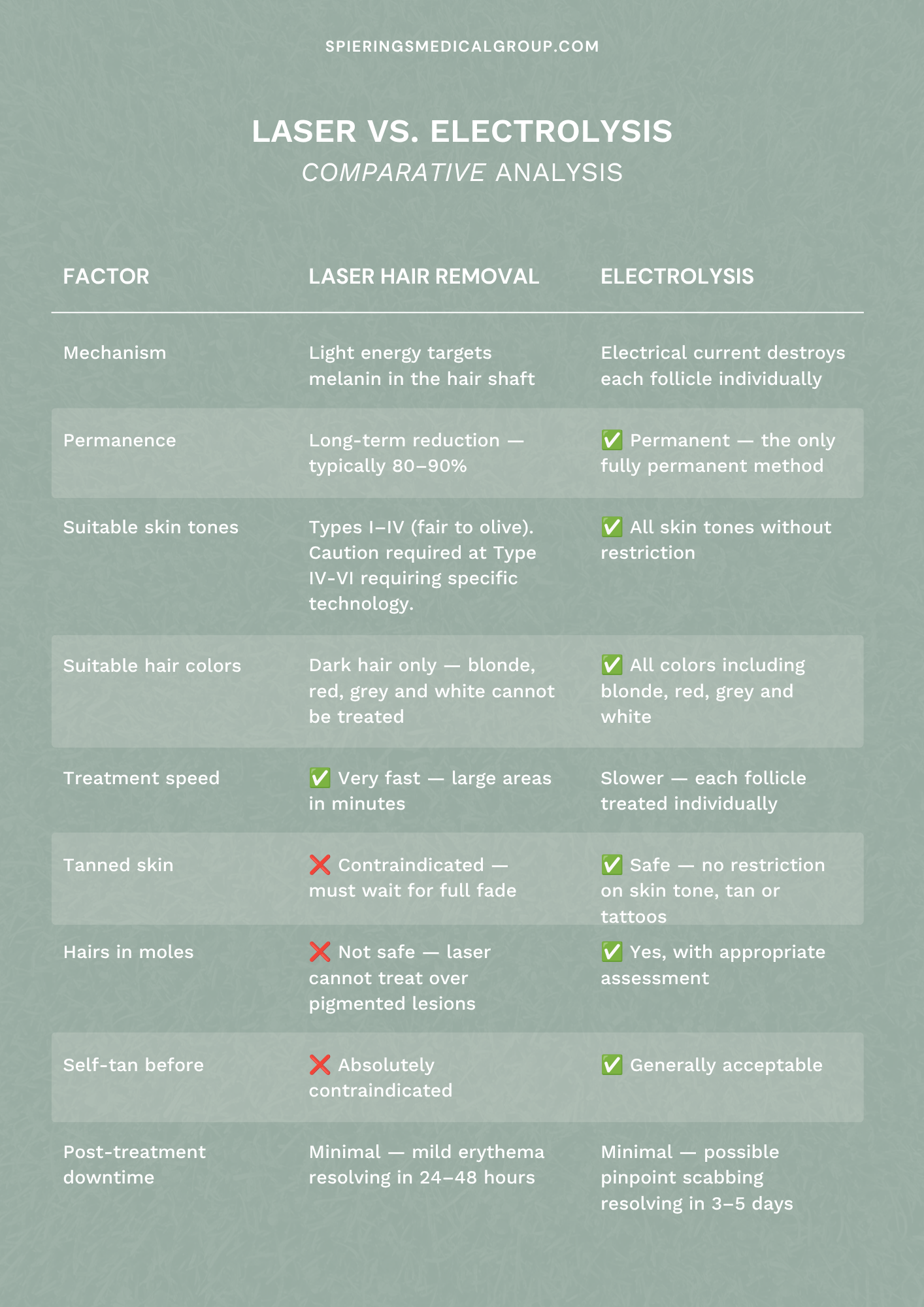
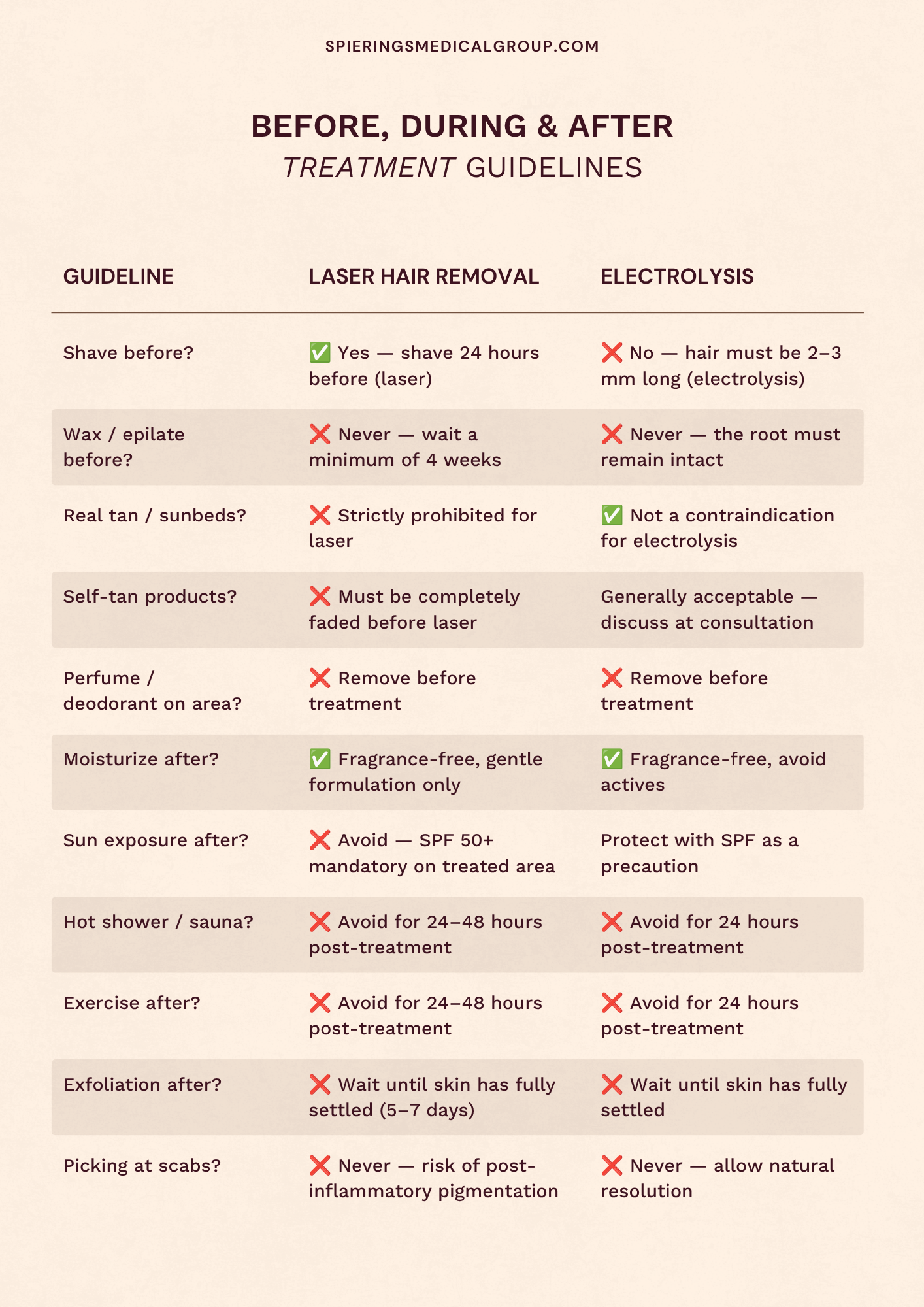
These are not competing treatments — they are complementary tools. The right choice depends on your skin tone, hair colour, treatment area, and goals. Many patients benefit from a combination of both.
Is Laser Right for My Skin and Hair Type?
Laser hair removal is most effective when there is strong contrast between hair colour and skin tone. It is appropriate for skin types I to IV (fair to olive) and works only on dark hair. Blonde, red, grey, and white hair cannot be treated because these colours do not contain enough melanin to absorb the laser energy. If laser is not suitable for your hair colour or skin tone, electrolysis is clinically appropriate for all patients without restriction.
What Happens After Treatment
Small red bumps and mild redness around treated follicles are a normal and expected response — clinically described as perifollicular oedema and erythema. This confirms that the laser energy has been effectively absorbed at the follicular level. In the majority of patients, erythema and perifollicular papules resolve within 24 to 48 hours.
Apply a chilled compress or fragrance-free emollient or aloe vera gel to the area. Avoid all thermal exposure — hot water, saunas, steam rooms, and vigorous exercise — for 24 to 48 hours. Do not apply topical actives (acids, retinoids, vitamin C), physical exfoliants, or fragranced formulations to the treated area until the inflammatory response has fully resolved.
Contact us promptly if erythema, swelling, or pain persists beyond 72 to 96 hours, or if you develop blistering, crusting, or any signs of secondary infection.
Preparing for Your Treatment
Required:
- Shave the treatment area 24 hours before your laser appointment. Do not wax or epilate
- Apply topical anaesthetic cream 20 to 40 minutes prior to your appointment if advised, under occlusion
- Arrive with the treatment area clean and free of all products — no deodorant, moisturiser, or cosmetics
- Disclose any new medications or changes to your skincare regimen since your last session
- Maintain adequate hydration in the days preceding treatment
- Wear loose-fitting clothing that allows unobstructed access to the treatment site
Not permitted:
- Do not expose the treatment area to UV light (sun or sunbed) for a minimum of 4 weeks before treatment
- Do not apply any self-tanning product to the treatment area. Ensure all residual tan has fully faded
- Do not wax, thread, epilate, or use any form of hair removal that extracts the root for a minimum of 4 weeks prior to treatment
- Do not apply tretinoin or any retinoid-class product to the treatment area for 5 to 7 days before treatment
- Avoid intense physical exercise, hot baths, saunas, or steam rooms on the day of treatment
- Do not apply perfume, oil-based products, or heavy emollients to the treatment area on the day of your appointment

Choosingtherightdoctororclinicshouldn'tfeelrushed.
If you have a question or want to know more before booking, just ask!